
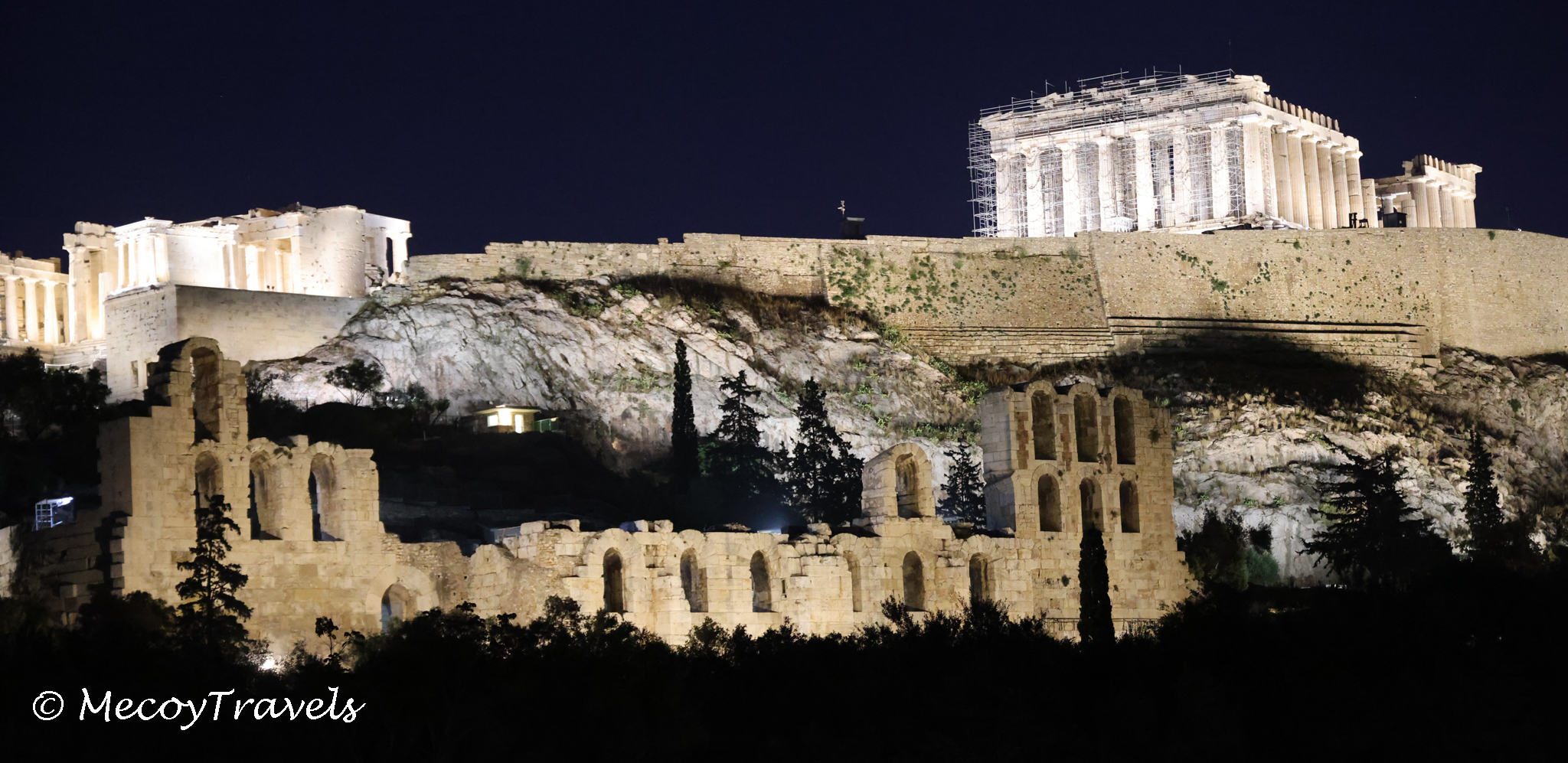
While the Greek islands beckoned, Athens had its own special appeal as the birthplace of arts, science, democracy and the philosophy of western civilization. One of the world’s oldest cities, it offers a vibrant modern city-scape with excellent hotels, parks, urban transportation, shopping, dining and night life. We traveled there in April, ahead of the summer vacation crowds but when the weather was warm enough to encourage outdoor excursions all over the city.
We enjoyed the night-time view of the Parthenon, pictured above and surrounded by scaffolding for repairs, from Dionysos Zonars restaurant, which describes itself as being at the crossroads of yesterday and today. Its cuisine is thoroughly modern, while the views are ancient.

A close-up view of the Parthenon at sunset. We arrived at the Acropolis shortly before sunset, the best time of day to view the monuments because the crowds are smaller and you can catch this golden glow on the monuments. It’s also cooler as the sun begins to set.


Two views of the Erechtheion on the north side of the Acropolis. At the back is the Porch of Caryatids, which has five female figures serving as support columns. These are replicas. The original ones are in museums now. Mythology says this is where Athena and Poseidon fought for patronage of the city and also as a burial ground for mythical kings.

Soldiers lower the flag at the end of the day at the Acropolis.

The Odeon of Herodes Atticus is a stunning open-air theater located beneath the Acropolis’ slopes. It was built by a wealthy resident, Herodes Atticus, between 160 AD – 174AD in honor of his late wife, Rigilla. As we stood above the theater, music wafted up to us. The musician wasn’t visible to us, so it was like a ghost of the past performing for us.

The changing of the guard at the Tomb of the Unknown Soldier is one of Athens’ most popular tourist attractions. Photos of the guards — wearing their blue pleated skirts with red trim, white stockings, leather shoes adorned with pom poms and designed to make a loud clacking noise as they march, bright red fishermen’s caps with tassels and dark blue jackets lined with shiny gold buttons — decorate tour buses and businesses. The monument honors all Greeks who have died in war. And the guards engage in an elaborately choreographed ceremony to mark the change from one set of guards to the next.


Hadrian’s Arch, or Hadrian’s Gate, honored the Roman emperor Hadrian and was built in 131-132 AD. It spanned an ancient road from the center of Athens to the complex of structures on the eastern side of the city that included the Temple of Olympian Zeus. Today, it stands at the edge of a park and frames a nearby very busy thoroughfare.

These sculptures were originally on the exterior of the Parthenon and are now in the Acropolis Museum, an archaeological site-specific museum, housing more than 3,000 famous artifacts from the Athenian Acropolis. Don’t miss visiting the ruins it’s built atop. You can see them through glass floors and walk through them underneath the museum.


The National Garden is an oasis in the heart of Athens. It’s a cool and relaxing spot with pieces of antiquity littering the grounds.
Leave a Reply